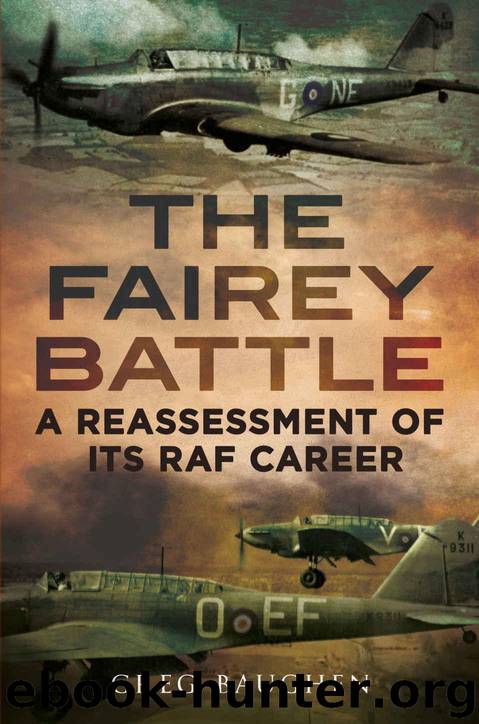
The Fairey Battle: A Reassessment of its RAF Career by Greg Baughen
Author:Greg Baughen [Baughen, Greg]
Language: eng
Format: mobi, azw3
ISBN: 9781781555859
Publisher: Fonthill Media
Published: 2017-06-10T22:00:00+00:00
Battle operations France May 1940.
On 17 May, it was decided to reduce the Battle force to six front-line squadrons. Nos. 105 and 218 Squadrons were to be withdrawn with their aircraft, and aircrews transferred to the remaining squadrons. The decision was not immediately implemented; No. 218 Squadron crews flew a few more sorties for their squadron before being formally transferred. The six remaining squadrons also sent as much unnecessary equipment to the rear as possible, in an effort to make themselves more mobile.35
There seemed to be enough Battles in store to keep these squadrons up to strength. No. 98 Squadron had arrived in March as a reserve and was able to provide replacement aircrews and planes. No. 142 Squadron only had three serviceable machines on the 19th, but was soon claiming a strength of twenty-five machines. Despite the heavy losses, the Battle squadrons were still a significant force. The only shortage appears to have been gunners. There was a suspicion in France, probably justified, that the gunner needs of the Bomber Command squadrons in the UK were getting priority. There were occasions when pilots had to fly on missions as gunners.36
From the 18th, some of the Battle squadrons had planes on standby, but only No. 103 Squadron appears to have flown any sorties, with its Battles bombing targets in the St Quentin area. The low-level approach had now been abandoned. With no fighter escorts available, there was no advantage to flying in formation; the combined firepower of a Battle formation was not enough to beat off attack. At least operating singly, or at most in pairs, the pilots could fly as fast as the Battle could take them and try to use the plane’s manoeuvrability to shake off chasing fighters. With a speed deficit of over 100 mph, it was hardly an option that was guaranteed to succeed, but the crews believed it was better than flying straight and level in formation and taking on the Messerschmitts toe to toe. On the 18th, the Battles flew singly at around 8,000 feet and attacked their targets in shallow dives, with instantaneously fused bombs dropped at around 4,000 feet. It worked on the 18th, with all No. 103 Squadron’s Battles returning.37
On the 19th, Nos. 12, 88, 103, 142, 150, 218, and 226 Squadrons were available for operations. This was the day de Gaulle launched his second counter-attack from the Laon region. D’Astier attempted to provide air support, but Barratt was no longer working alongside the French Air Force commander and does not seem to have been aware any French attack was taking place. Indeed, Barratt was very much in the dark about what was happening anywhere along the front. He knew that German forces were advancing beyond the Montcornet–Neufchâtel road, and his own reconnaissance confirmed that there were substantial German forces to the east of this line, north of Rethel. These were a potential threat to his bases further south, so Barrett ordered all except No. 226 Squadron to attack by day,
Download
The Fairey Battle: A Reassessment of its RAF Career by Greg Baughen.azw3
This site does not store any files on its server. We only index and link to content provided by other sites. Please contact the content providers to delete copyright contents if any and email us, we'll remove relevant links or contents immediately.
| Africa | Americas |
| Arctic & Antarctica | Asia |
| Australia & Oceania | Europe |
| Middle East | Russia |
| United States | World |
| Ancient Civilizations | Military |
| Historical Study & Educational Resources |
The Radium Girls by Kate Moore(12112)
100 Deadly Skills by Clint Emerson(4984)
Rise and Kill First by Ronen Bergman(4857)
The Templars by Dan Jones(4751)
The Doomsday Machine by Daniel Ellsberg(4576)
The Rape of Nanking by Iris Chang(4276)
Killing England by Bill O'Reilly(4065)
Stalin by Stephen Kotkin(4024)
Hitler in Los Angeles by Steven J. Ross(3993)
12 Strong by Doug Stanton(3590)
Hitler's Monsters by Eric Kurlander(3412)
The Code Book by Simon Singh(3269)
Blood and Sand by Alex Von Tunzelmann(3256)
Darkest Hour by Anthony McCarten(3184)
The Art of War Visualized by Jessica Hagy(3058)
Hitler's Flying Saucers: A Guide to German Flying Discs of the Second World War by Stevens Henry(2785)
Babylon's Ark by Lawrence Anthony(2744)
Tobruk by Peter Fitzsimons(2575)
The Second World Wars by Victor Davis Hanson(2559)
